
Price is rarely the only thing that matters when a compliance team evaluates an AML tool. But it is almost always the thing that ends the conversation, one way or another.
So it is worth asking: are you comparing the right number?
Most procurement conversations focus on feature sets, integration timelines, and the license fee. What tends to get skipped is a quieter but equally real cost: the data the tool needs to actually do its job.
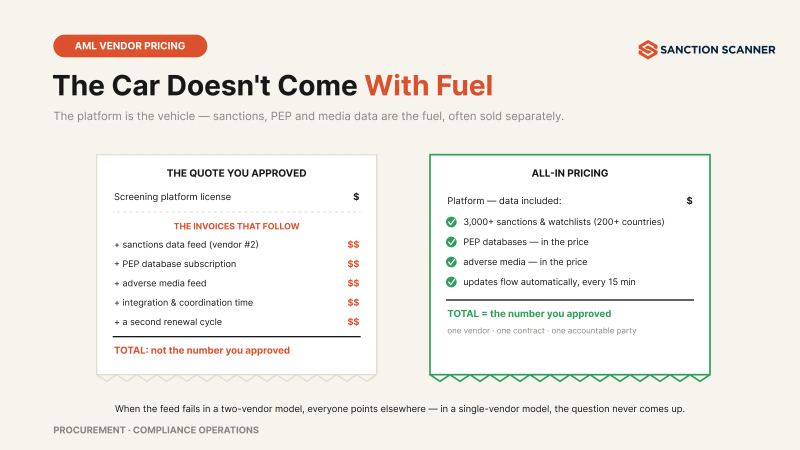
Think of it like buying a car without accounting for fuel. The compliance platform is the vehicle. It gets you where you need to go. But without data, sanctions lists, PEP databases, adverse media feeds, it does not move. These are not add-ons. They are what the engine runs on. And across much of the market, that fuel is sold separately.
The budget math does not add up the way you think
Compliance is already one of the most expensive obligations a financial institution carries. A 2024 study put the annual cost of financial crime compliance in the US and Canada alone at over $61 billion. Within that figure, personnel accounts for roughly 79 cents of every dollar spent. Technology sits at around 9%.
(There is a reasonable argument that AI adoption will shift this balance over time. But that shift has not happened yet for most teams.)
When your tech budget is already that tight, a surprise add-on does not just feel annoying. It breaks things. A data subscription that nobody budgeted for means reopening an approved budget mid-cycle, a conversation that finance teams do not welcome. It means a second vendor assessment, legal sign-off, security review, contract negotiation, all of which can take weeks. And it means explaining to the CFO why the number that was approved is no longer the number on the invoice.
That is not a compliance problem. That is an organizational headache that lands squarely in the compliance team's lap.
The tool and the data are often two different businesses
Here is the part that does not get talked about enough: Most AML screening tools do not own the data they screen against.
The sanctions lists, PEP databases, and adverse media feeds that produce the results come from third-party data providers with their own contracts, their own renewal cycles, and their own pricing. The screening platform is the mechanism. The data that feeds it belongs to someone else.
One compliance platform describes this openly in its own marketing materials: a widely used risk data provider is "not a complete AML/KYC platform. To operationalize it, you need additional tools, often spreadsheets, internal systems, or custom integrations."
This is the industry acknowledging, in plain language, that buying the tool is not the same as buying a working solution. You are purchasing access to a mechanism that still needs a second contract, a second vendor, and a second invoice before it can do what it was sold to do.
There is also a practical accountability gap that comes with this setup. When a sanctions list update arrives late or a data feed returns incomplete results, who is responsible? The tool vendor will point to the data provider. The data provider will point to the feed schedule. In a two-vendor model, that question has no clean answer. In a single-vendor model, it never comes up.
The regulatory environment makes this more urgent, not less
When a vendor includes data within the platform price, it means the screening function works out of the box. No secondary contract required.
One vendor, one contract, one renewal conversation. List updates flow through automatically. There is no coordination step between the software team and a separate data team. The compliance function runs as a single thing, because it is a single thing.
Since early 2022, the pace of sanctions updates from OFAC, the EU, and the UK has climbed sharply, with additions sometimes coming multiple times in a single week. Data freshness is no longer a nice-to-have. In a fast-moving sanctions environment, a lag of even a day or two carries real regulatory exposure.
Regulatory pressure is not easing. If anything, it is consuming more of leadership's time than ever. A Bank Policy Institute survey found that C-suite executives at major financial institutions now spend 42% of their working hours on regulatory compliance, nearly double the 24% recorded in 2016. For executives already stretched that thin, every vendor relationship, every contract, every additional tool in the compliance stack is one more thing that can go wrong. Simplicity is a must in that environment.
A fragmented vendor setup introduces coordination risk precisely where you cannot afford it.
One number should cover everything
Not every vendor in this space operates the same way. Sanction Scanner includes sanctions data, PEP lists, and adverse media within the platform price. With the power of AI, Sanction Scanner, as a standalone data provider, collects and structures more than 3000 sanctions and watchlists worldwide, namely + 200 countries.
There is no separate data subscription. No third-party data contract. No renewal that catches your finance team off guard.
If you are currently weighing up AML screening options, or taking a fresh look at what your existing setup is actually costing you, the right question is not just what is the license fee. It is what does the whole thing cost once the data is included.
You can start a demo process with filling the form in the link below.