
Ask seemingly simple question to a compliance officer at a mid-sized bank or fintech how many tools their team logs into on a typical workday. The answer is rarely one. More often it is four, five, sometimes more. A name screening solution, a separate transaction monitoring system, a customer risk assessment module, a KYC onboarding tool, ongoing monitoring running in the background. Each with its own interface, its own vendor contract, its own support line, and its own data model that does not talk to the others.
Sounds crowded, isn’t it?
This is what AML and compliance teams are drawing in: A pool of tools which costs organizations more and more everyday.
What The Numbers Tell Us
Global financial crime compliance now costs an estimated $275 billion per year. In 2024, 99% of U.S. financial institutions reported that their compliance costs increased year-over-year, with the total for North American firms alone reaching $61 billion.
In the UK, banks and fintechs spend £21,400 per hour fighting financial crime. These figures reflect the increase on the cost of doing compliance and making it inefficiently creates a heavier burden on the organizations.
One of the common factors laying behind the costly inefficiency is because of fragmented tooling.
And the future seems to bring more tools.
The RegTech market is projected to exceed $22 billion by mid-2025, growing at 23.5% annually. That growth has flooded the market with specialized point solutions, each excellent at one task, but rarely designed to work together.
The result is what industry analysts now call a "fragmented compliance stack" which means a collection of tools assembled over time, from different vendors, covering different parts of the AML workflow, with no unified view across any of it.

How to Identify Fragmentation in Your Tech Stack
The most visible symptom is data silos. When a customer's screening results sit in one system, their transaction history in another, and their risk score in a third, compliance officers spend a significant portion of their day manually pulling information together.
A survey found that 45% of respondents cited poor-quality, siloed data as a top barrier to financial crime risk detection. The connection between a customer's behavior across different products and channels is precisely where red flags often emerge, and that connection is hardest to see when the data lives in separate tools.
False positives compound the problem. Let’s face it: AML alert systems at large institutions face up to 90-95% false positive rates, generating roughly 950 false alerts per million daily transactions. Each one requires approximately 30 minutes of investigation time. The industry-wide cost of chasing false positives is estimated at $3 billion annually. When monitoring rules and risk signals are spread across multiple disconnected systems, teams have no shared context to triage alerts efficiently, and false positive rates stay high.
The complication of Vendor management with the rise of the number of tools poo is an undeniable burden. Every additional tool means another contract negotiation, another renewal cycle, another integration to maintain, another team to train. And sometimes another waste of time…
We have heard several times from industry experts that firms are paying for multiple solutions and still not getting the efficiency or insight they need, because data remains siloed. It is essentially paying more for less.
Fragmentation in tech stack is not only an efficiency problem. Regulatory risk rounds out the picture. Regulators in 2024 and 2025 have been explicit: Fragmented oversight is not an acceptable compliance posture. The 2025 AML crackdown saw U.S. regulators issue approximately 139 penalties totaling $1.23 billion in the first half of the year alone, a 417% increase over the same period in 2024. Many cited failures traced back to fragmented tools and legacy workflows.
The message from regulators is clear: If your monitoring is split across different platforms, you risk missing patterns that span business lines, and criminals know it.
Not Quite A New Phenomenon
It is something that practitioners have been raising consistently in conversations about their compliance programs. Enterprises managing compliance across multiple subsidiaries and jurisdictions have pointed directly to the consolidation problem. Using multiple screening tools and wanting to move to one. The operational drag of managing separate contracts, data pipelines, and alert queues across different systems is not practical at all. It is a daily friction point for the compliance officers responsible for keeping those systems running and aligned with each other.
The Aventine Lab's 2025 analysis of AML compliance gaps put it plainly: "Tech is meant to simplify, but poorly integrated RegTech stacks can actually increase operational risk." The market has created a paradox where more tools create more complexity rather than more coverage.
What a unified platform actually changes
One can suggest that the alternative is not simply buying fewer tools. It is replacing the fragmented stack with a platform where every compliance function shares the same data model, the same customer record, and the same operational context.
In a unified environment, ideally a customer who triggers a name screening alert can be cross referenced immediately against their transaction history and risk score without switching systems. Ongoing monitoring updates the same customer profile that KYC onboarding created. Customer risk assessment draws on live data from transaction monitoring rather than static inputs entered at onboarding. This holistic view of customer behaviour lead the ability to assess risk across all channels and products from a single, consistent data layer.
The operational gains from consolidation are measurable. Some forecasts that U.S. financial institutions stand to save $23.4 billion through AI-powered unified compliance solutions.
False positive rates drop when alert triage has full customer context. Vendor management overhead falls when a single contract covers the full compliance workflow. Onboarding time for new products and geographies compresses when there is no multi-vendor integration project to coordinate. Perhaps most importantly, a unified platform closes the detection gaps that regulators are increasingly focused on. When monitoring is enterprise-wide rather than product-silospecific, the behavioral patterns that sophisticated financial crime generates across accounts and channels become visible in ways that fragmented systems cannot support.
This is not a dream
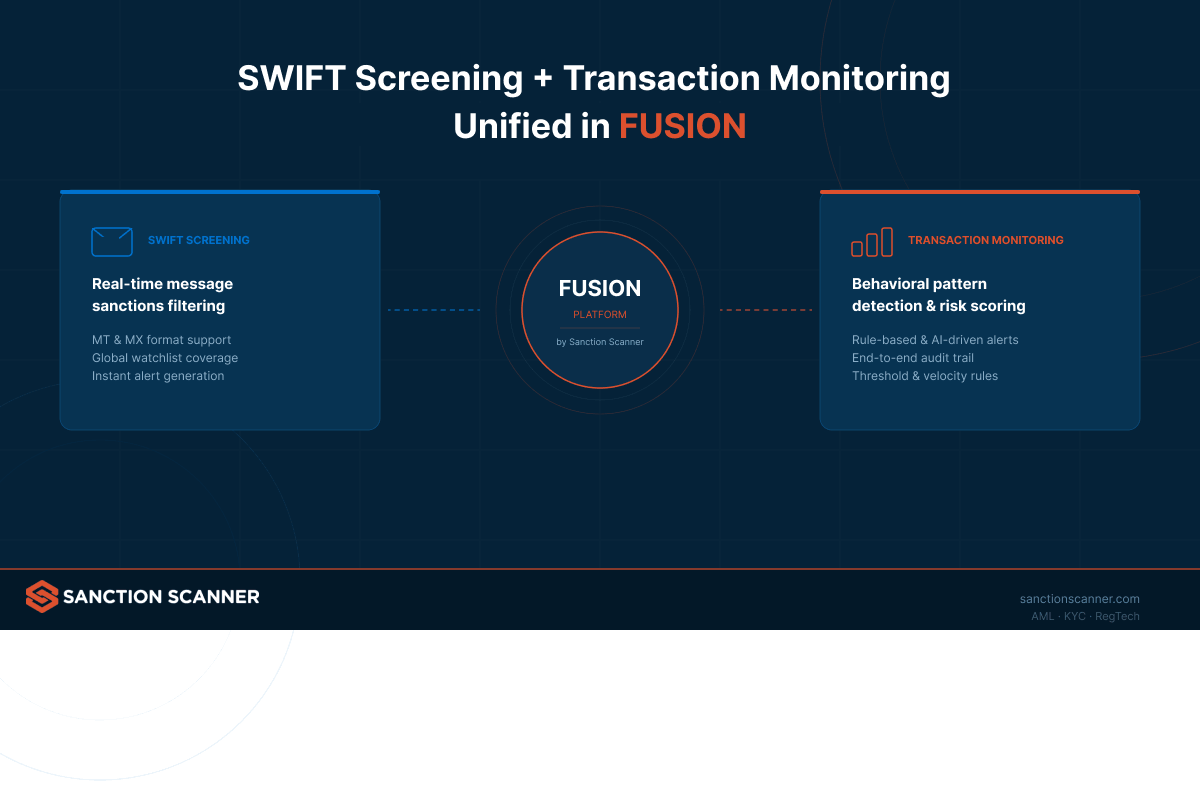
Sanction Scanner's Fusion platform brings together the full AML compliance workflow: Name screening and ongoing monitoring, transaction monitoring, customer risk assessment, and KYC in a single environment.
Every tool shares the same customer record. Alerts from one function are visible alongside data from others. Risk scores update continuously as new information comes in across any part of the platform.
The Unified Customer View, introduced in Sanction Scanner V3, is the operational expression of the unified approach. A single screen where compliance officers can see screening history, KYC documentation, transaction behavior, risk scores, and customer analytics without switching systems or logging into separate tools.
We are calling this consolidated platform Fusion. More on that soon.
See how Sanction Scanner's platform works: