When onboarding, sanctioned individuals and politically exposed persons (PEPs) are required to be identified by regulated sectors. These companies are required to do sanctions checks and PEPs as part of their due diligence in order to meet KYC and AML regulations. Preventing the risks is possible by incorporating screenings into your Know Your Customer (KYC) program. In particular, PEP checks and sanctions screenings are essential for identifying clients who might be more likely to perpetrate money laundering or other forms of financial fraud, in a comprehensive KYC/AML procedure. The following topics are going to be discussed in this article;
- The Fundamental Difference: Blocking vs Enhanced Scrutiny
- What Is a Politically Exposed Person (PEP)?
- What Is a Sanctioned Person?
- Side-by-Side Comparison Table
- When Someone Is BOTH a PEP AND Sanctioned
- Why You Need Both Checks in a Single Workflow
- Common Mistakes Compliance Teams Make
1. The Fundamental Difference: Blocking vs Enhanced Scrutiny
People who have an excessive amount of political power or who are close to prominent government figures are known as politically exposed persons, or PEPs. PEPs may be more likely to engage in actions that expose them to financial misconduct because of their position and connections. High-ranked members in diplomatic, judiciary and military roles or political parties are often most likely to be screened as PEPs. Central banks, state-owned businesses or financial institutions are included. Their close acquaintances through professional connections and family members are also included in this description. Even after leaving a political job or ending a connection with another PEP, a person is still considered "politically exposed." The definition of politically exposed individuals, even those who are no longer in political positions or who are associated with people with political status, is left to each organization to decide using a risk-based approach. Although doing business with PEPs is not illegal, it is crucial to control the danger they pose.
To put it simply, a sanctioned individual cannot be your customer, but a PEP may. Mistaking one for the other in the realm of financial compliance is more than simply a "rookie move"; it can mean the difference between a stressful afternoon of paperwork and a disastrous legal meltdown. Although they both need attention, they set off two very distinct protocols: one is about risk management, and the other is about legal restriction.
Sanctions are the "Hard Stop". Instead of being advisory, the law issues orders when you find a match on a sanctions list, such as OFAC's SDN list. Dealing with a sanctioned person or organization is a legally forbidden entrance area. The transaction must be rejected right away, or assets must be blocked or frozen. This is more than a simple regulatory detail. It is illegal to violate sanctions. The International Emergency Economic Powers Act (IEEPA) stipulates that each infraction carries a potential of massive fines up to $1 million and a sentence of 20 years in jail and/or the loss of the license in the worst case scenarios. Sanctions are a tool for both national security and international policy. The government seeks to isolate potential security risks by restricting financial access.
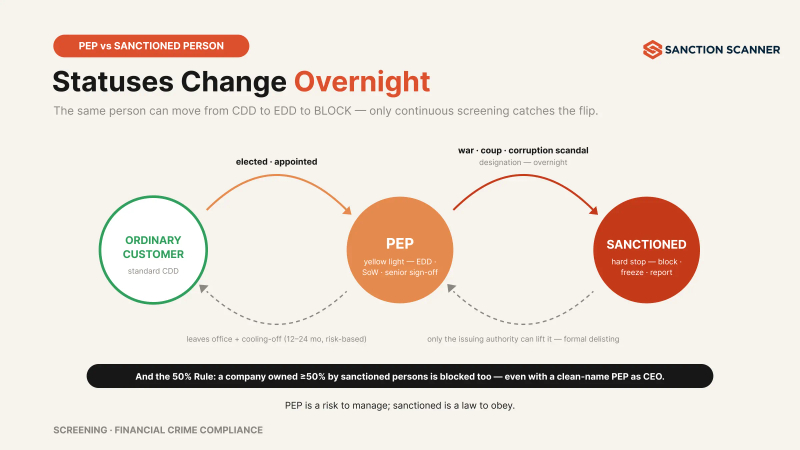
Compared to sanctions screening, PEPs can be considered as the "Yellow Light". A person who currently holds or has held a high-profile public position like head of state, senior politician, or judicial authority is known as a Politically Exposed Person (PEP). Being a PEP only increases their chances of engaging in corruption or bribery; it is not a crime. In this case, Enhanced Due Diligence (EDD) must be employed. This entails investigating their Source of Funds (SoF) and Source of Wealth (SoW) in greater detail.
Risk management is the responsibility of your organization. Banking a PEP is not illegal, but you must demonstrate that you have closely examined their operations to make sure they aren't laundering "dirty" money. Most politicians are recognised as genuine by compliance frameworks with their "proximity to the purse" which renders them high-risk to be analyzed.
In geopolitical regions of crisis or conflicts, the distinction frequently becomes hazy. Both procedures serve distinct purposes even though they are both necessary for risk management and due diligence. Many of today's most well-known sanctioned individuals were once PEPs. A PEP instantly changes from "scrutinize" to "block" when it is included on a list such as the OFAC SDN list.
2. What Is a Politically Exposed Person (PEP)?
The PEP can be thought of as having proximity to the purse. They have easier access to public resources and funding and more influence than the citizens with their status. They are not fraudulent by definition, but rather because their potential of power and resources makes them a high-risk target for bribery, corruption, and money laundering. It is completely legal to be a PEP. The majority of PEPs are actually law-abiding public employees. It all comes down to monitoring. Compliance staff mark PEPs in order to keep a closer eye on their accounts. The PEP flag makes sure the bank notices and inquires if a junior government official with a modest income unexpectedly deposits millions in cash.
FATF Recommendation 12, which mandates that financial institutions take particular steps for these individuals, serves as the global standard for this classification. Not every well-known politician appearing on the news is a PEP. The wide category often consists of:
- Heads of state and government include monarchs and presidents.
- Senior cabinet ministers and members of political parties.
- Military leaders are senior military officials.
- High court officials or senior judges.
- Executives of state-owned enterprises, like national banks or state oil companies.
- The Inner Circle (RCAs) consists of close associates and relatives. People who have close ties to a PEP, such as advisors, business partners, or personal associates, are known as close associates. Family members of a PEP, such as spouse, children, parent, sibling, are typically affected by the PEP moniker as well.
- People who hold political positions in a specific nation are known as domestic PEPs. Foreign PEPs have relevant or political positions in another nation. International PEPs are representatives of global institutions like the International Monetary Fund (IMF) and the United Nations.
As they have varying degrees of access to resources, authority, or both, not all PEPs carry the same risks. While top military officers and top management of state-owned enterprises are categorized as medium-risk, mayors and members of local district legislatures are typically regarded as low-risk for instance.
Heads of state, members of the federal or national government, leaders of the armed forces and law enforcement, and central bank board members on the other hand, are instances of high-risk PEP.
3. What Is a Sanctioned Person?
A sanctioned individual or entity is a person or organization that has been officially blacklisted or excluded from the global financial system by a government or international organization. It is a brick wall that requires more than just being cautious like PEPs. Financial transactions are legally prohibited for anyone who has been placed on a sanctions list in that jurisdiction. The most important lists are as follows:
OFAC SDN List (USA): US sanctions have an extraterritorial reach, which means that non-US individuals may be subject to them if a transaction has even a passing connection to the US. These connections can be utilizing US technology, US correspondent banks, or clearing transactions in US dollars. The US dollar's prominence in the world economy is another factor in this outcome. OFAC SDN List provides a gold standard for international sanctions screening. A person's assets are restricted if they are a Specially Designated National (SDN), and dealing with them is absolutely prohibited for persons of U.S.
UN Security Council Consolidated List: Since the UN Security Council authorized , they have the highest degree of worldwide jurisdiction. These measures mostly target terrorism and the spread of weapons of mass destruction. All UN member nations must abide by this list in order to prevent threats to global stability.
EU Consolidated List: Through Council Regulations, the EU enacts restrictive restrictions that are immediately applicable in each of its member states. The EU upholds autonomous regimes for democracy and human rights while enforcing UN sanctions.
The UK Sanctions List (HMT): This is controlled by OFSI, is now the only reliable source for all designations unique to the UK as of early 2026. All UK sanctions designations can now only be found on the UK Sanctions List. After closing in late January 2026, the OFSI Consolidated List of Asset Freeze Targets is no longer updated. Its previous page is accessible for reference.
Sanctions are a subject of foreign policy as an instrument of statecraft, not just rules per se. They are used by governments to apply pressure without using force. Usually, they are utilized for:
- An effective way to fight terrorism is to cut off money to extremist groups.
- One strategy to prevent aggression is to penalize governments for encroaching on sovereign territory.
- Helping to stop violations of human rights by concentrating on individuals who have committed serious crimes.
- Preventing the spread of nuclear or chemical weapons is referred to as "proliferation prevention."
Sanctions compliance is rule-based and absolute, in contrast to the risk-based strategy utilized for PEPs. Not following the sanctions regulations is illegal. Violations of the IEEPA sanctions in the United States carry a fine up to $1 million and a sentence of 20 years in prison in a bad case. Even if you didn't intend to break the law, you may still face consequences. You are responsible if you handle a payment for someone who has been sanctioned. Stricter monetary penalty programs have been lately implemented by contemporary enforcement organizations like the UK's OFSI. It permits hefty civil penalties even in the absence of a criminal conviction.
The "designation" process has accelerated lately. A coup, a conflict, or a corruption scandal can suddenly make a PEP a sanctioned individual. The only way to be sure your "high-risk" PEP hasn't turned into a "prohibited" Sanctioned Person is through ongoing screening.
4. Side-by-Side Comparison Table: PEP vs Sanctioned Person
The regulatory environment has transformed to include more real-time monitoring. To assist you quickly differentiate between these two crucial compliance categories, a detailed comparison between PEPs and sanctioned persons is provided below;
|
Feature |
Politically Exposed Person (PEP) |
Sanctioned Person |
|
Legal Basis |
FATF Recommendation 12 & 22 as global standards for AML/CFT. |
OFAC, EU, UN, & UK Sanctions Regs as legal prohibitions. |
|
Primary Scope |
Controlling the potential risks of corruption, bribery, and money laundering. |
Carrying out foreign policy, national security, and counter-terrorism. |
|
Data Sources |
Commercial databases like World-Check, ComplyAdvantage, and news, public records. |
Official government lists like OFAC SDN, UN Consolidated, UK Sanctions List. |
|
Required Action |
Enhanced Due Diligence as in Verifying Source of Wealth and Source of Funds. |
Block / Freeze / Reject. Immediate cessation of all financial dealings and reporting to authorities. |
|
Can they be a customer? |
Yes. Usually requires Senior Management approval and ongoing monitoring. |
No. Dealing with them is a legal violation of the highest order. |
|
Ongoing Monitoring |
Periodic review. Frequency based on their specific risk score. |
Continuous / Real-time. Transactions must be screened against live lists 24/7. |
|
Consequences of Failure |
Regulatory fines, "Grey Listing," and severe reputational damage. |
Criminal prosecution as in up to $1M/20 years per violation, and loss of banking licenses. |
|
Declassification |
Risk-based expiry. Status can be downgraded once they leave office and typically after a cooling-off period/risk review. |
Issuing Authority. Status only changes if the government formally lifts the sanction. (recent Venezuela relief in 2026). |
Table 1: Comparison table of PEP and Sanctioned Person
5. When Someone Is BOTH a PEP AND Sanctioned
The most important PEPs like heads of state, ministers, and oligarchs are also the main targets of sanctions in many high-stakes geopolitical confrontations. It's the danger zone of compliance. Vladimir Putin and the designated government officials are an example for this situation.
The sanctions obligation overrides when a PEP match and a sanctions match happen at the same time. Assets are blocked , and the appropriate authority as in OFAC or OFSI is notified right away. Doing enhanced due diligence to determine if they can be kept, is not the procedure anymore at this point. As a result, the sanctioned status has legally barred them from using the financial system, and the PEP status is not the topic of discussion.
The challenge here is unsanctioned PEPs in sanctioned jurisdictions, which is the gray area that compliance teams struggle with. The people connected to the list are the subjects of discussion, not the individuals which are already on the sanctioned list. A state-utility director in Iran or a regional governor in Russia who is not specifically listed on an SDN list are examples.
According to OFAC, EU, and UK regulations, an organization is deemed sanctioned by operation of law if it is owned by one or more sanctioned individuals to a degree of 50% or more. The ownership rule applies whether the percentage is reached individually or collectively. The tricky situation is when such a corporation has a non-sanctioned PEP as its CEO. it is still unlawful to do business with the non-sanctioned PEP's company, and sanction rules are applied. The following is a Red Flag checklist for PEPs from sanctioned nations who are not specifically sanctioned:
- Sudden wealth shift from a sanctioned relative to this PEP just before/after a conflict began.
- Shell company use with no clear commercial purpose.
- Third-country hop by conducting business through a newly formed entity in a country with no sanction issues.
- Circular funding which originates from a state-owned enterprise in a sanctioned jurisdiction.
The struggle of the compliance team is over-compliance and de-risking. Many banks merely de-risk by prohibiting PEPs from specific nations. According to the FATF's risk-based approach, de-risking refers to the practice of financial institutions ending or limiting business connections with clients or groups of clients in order to avoid rather than manage risk. Concerns about profitability, prudential standards, worry following the global financial crisis, increased regulatory demands, or reputational risk are some of the reasons for de-risking. FATF and other regulatory bodies have cautioned that a general de-risking approach may push illegal cash underground. It is anticipated that you will possess the surgical data tools necessary to distinguish between a legitimate businessperson and a front for a sanctioned dictatorship.
6. Why You Need Both Checks in a Single Workflow
Manual screening is not a solution and not possible in the present regulatory climate. The amount of international transactions are enormous and the sanctions lists are volatile. A centralized, tech-driven process that combines PEP, penalties, and adverse media screening into a single, cohesive customer picture is necessary for modern institutions. Separate checks generate unmanageable data that hinders your company in important ways:
- Two different warnings will be triggered if the client is both a PEP and a sanctioned person. The same individual is ultimately the subject of two investigations by your team. This is not an uncommon instance.
- System A may mark a PEP as "Medium Risk," yet the sanctions system may mark them as "Prohibited." This results in inconsistent risk scoring.
- You must collect records from two separate databases and hope they match when asked. Each client having a single, coherent story is handy and preferable.
- Doubling the storage sets, API calls, and the amount of manual effort results in doubling the total costs.
A unified screening workflow checks both datasets at once with a single API query. The alert volume and the high risk of manual errors reduces with the help of a single source of the truth. Audit trails are not fragmented. You receive a consolidated action indicator like ‘block’, ‘apply edd’, or ‘clear’ instead of a mountain of raw data.
7. Common Mistakes Compliance Teams Make
Compliance in high-stake situations entails avoiding the strategic pitfalls that might result in significant fines or lost revenue. Here are the common mistakes compliance teams make:
- Treating PEPs like Sanctions: Treating a PEP match with the same "hard stop" as a sanctions match is one of the common mistakes. In order to minimize the paperwork associated with EDD , some businesses automatically reject or "de-bank" PEPs. The consequence that follows is "de-risking" , which is the mass withdrawal of customer groups. This action path has been specifically criticized by regulators like FATF for the risk of pushing financial activity underground. A powerful compliance platform offers clear action triggers, and lets you remain the legal high-value clients.
- Ignoring PEPs: Many U.S.-based businesses have historically had inadequate domestic PEP screening because the Bank Secrecy Act (BSA) has generally placed more emphasis on international PEPs. Updated guidelines clearly highlight the fact that domestic officials continue to present serious corruption risks. Ignoring a state official or municipal mayor implicated in a procurement scam may result in harsh "look-back" audits and "Cease and Desist" orders from FinCEN or the OCC. In order to make sure that no one falls between the cracks, no matter where they live, modern systems make use of comprehensive global databases that contain domestic, municipal, and regional PEPs.
- Lack of Integration: For sanctions, many teams utilize a single tool, while for PEPs, they employ a separate manual procedure or searches. The result is a fragmented audit trail. The good faith justification vanishes if you are unable to provide a regulator with a single, timestamped report attesting to the fact that both checks were completed during onboarding. It should be certain that each check is recorded in a single golden record. API-First Integration offers examiners a unified audit trail that is instantly accessible.
- Ignoring Status Changes: A client who was a private person yesterday might be elected to the legislative body the next day. On the other hand, a PEP who left office a few years ago might suddenly be considered "declassified" or less dangerous. Either you squander resources on "zombie risk" , which is the previous PEP who is now a low-risk citizen, or you carry unmonitored risk with the new PEP. Continuous monitoring is necessary to be notified as soon as a customer's status changes in the global database, They are placed in or out of the PEP category in real-time.
- The Assumption of PEPs as Criminals: Seeing every PEP match in a money laundering activity can be adopted by compliance teams with a policing mentality. This leads to conflict with the front desk and possible legal backlash from clients. It transforms a risk-management activity into a hostile one. PEPs can be analyzed and sorted according to their country of origin and specific position using risk scoring engines. Instead of conducting a one-size-fits-all questioning, a sliding scale of scrutiny can be employed.