
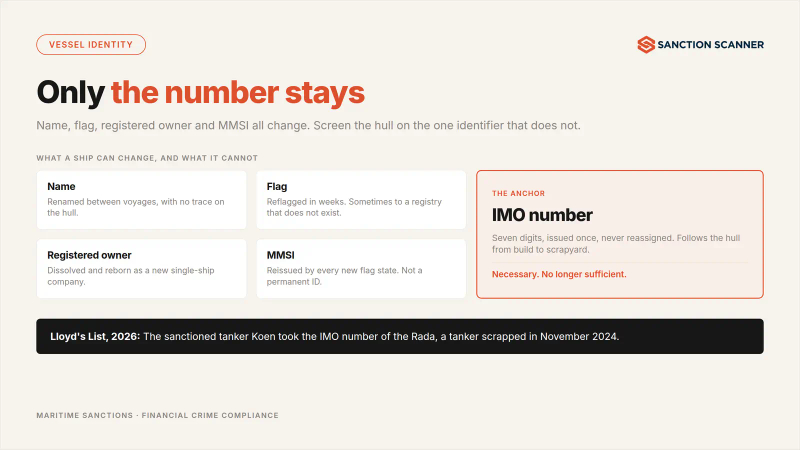
A ship is one of the few sanctions targets that can change nearly everything about itself and keep trading. Names get swapped. Registered owners dissolve and reappear as new single-ship companies in a different jurisdiction. Flags move from one registry to another in a matter of weeks. A vessel flagged Cameroon last month and Comoros this month can surface as two different results depending on when your screening tool took its snapshot. The only piece that stays fixed is the International Maritime Organization (IMO) number, the seven-digit identifier that follows a hull until it is scrapped, regardless of changes in flag, ownership, or name.
The volume of listings has grown fast enough to change how compliance teams work. Brookings Institution tracking puts the EU at 671 sanctioned shadow fleet ships as of July 2026, up from 25 in July 2024, with the UK at 621, up from 17 over the same period. On the US side, well over 300 vessels were added individually to the SDN List during 2025, and that figure excludes ships blocked automatically because an SDN owns half or more of them. A name that cleared last quarter may not clear today.
This is why screening splits into three layers. The vessel is checked against designation lists using its IMO number rather than its name. The owner, manager, operator, and beneficial owner are checked through corporate structures, where OFAC aggregates ownership across multiple designated persons while the UK test turns on whether a single designated person holds more than half. The flag is verified against the registry that supposedly issued it, because the IMO had identified 529 ships flying false flags by February 2026.
Lists alone no longer settle the question. OFAC's April 2025 advisory widened the definition of red-flag behavior and pushed stakeholders toward continuous, behavior-based assessment rather than static checks. Clean list results plus a dark Automatic Identification System (AIS) gap in a known transfer zone is still a problem, and regulators now expect you to treat it as one. The following topics are going to be covered in this article:
- What Vessel Sanctions Screening Involves
- Screen by IMO Number, Not Just the Name
- Screening the Ownership and Operator Chain
- Flags, Registries, and Flag-Hopping
- The Shadow Fleet and Deceptive Shipping Practices
- A Vessel Screening Checklist
- How Sanction Scanner Helps
1. What Vessel Sanctions Screening Involves
Vessel sanctions screening checks a ship and the parties connected to it against sanctions lists. Unlike screening a person or a company, a vessel carries several screenable attributes at once. There is the IMO number, the current name, the flag state, and the chain of registered owner, beneficial owner, technical manager, commercial operator, and charterer. Each is a separate lookup, and each can return a different answer.
The reason the work splits this way is that a ship is property rather than a person, so it can be caught by sanctions without ever appearing on a list under its own name. Vessels become subject to blocking sanctions simply by being 50 percent or more owned by designated persons, which is why headline designation counts always understate real exposure.
The three main regimes also list ships differently, and the differences are operational rather than academic.
- United States. OFAC adds vessels to the SDN List as blocked property, published with identifiers such as IMO number, Maritime Mobile Service Identity (MMSI), and call sign. The list covers individuals, entities, and vessels alike, and a ship can be blocked with no separate listing if its owning company crosses the aggregate 50 percent threshold.
- European Union. Designated vessels sit in Annex XLII to Regulation 833/2014 and are not subject to asset freezes. They face port and service bans instead, covering access to EU ports, anchorages, and locks, plus flag registration, financing, insurance, brokering, crewing, chartering, and ship-to-ship transfers.
- United Kingdom. Ships are "specified" under the Russia Regulations, and the legislation requires the Secretary of State to specify a ship by its IMO number wherever that is reasonably practicable. A specified ship is barred from UK ports, can be detained, and can have its UK Ship Register entry terminated. Amendments in force from 20 May 2026 added broad service prohibitions covering technical assistance, crew, operating, and chartering services.
One hull can therefore be blocked property in Washington, port-banned in Brussels, and specified in London, with three different consequences attached. A clean result under one regime tells you nothing about the other two.
In practice, a full screen covers four things. Identity, meaning IMO number, MMSI, call sign, and current and former names. Ownership, meaning the corporate chain up to the ultimate beneficial owner. Flag, meaning verification that the claimed registry actually issued the registration. Behavior, meaning Automatic Identification System (AIS) gaps, ship-to-ship activity, and port call history, which are not visible in the lists themselves.
Vessel screening also sits next to counterparty screening rather than replacing it. Checking the shipowner, charterer, or cargo owner sanctions lists is a separate exercise, and the working standard is to run both.
For a plain-language definition, see our vessel screening knowledge base entry. This guide covers how to actually run vessel screening operationally.
2. Screen by IMO Number, Not Just the Name
Screening by the IMO number is the rule everything else rests on. A vessel's name and flag can be changed. The IMO number cannot. The seven-digit number was created under IMO Resolution A.600(15) in 1987. It has been mandatory since 1996 for passenger ships of 100 gross tonnage and above and all cargo ships of 300 gross tonnage and above. The IMO number survives changes of name, flag, and owner. It is issued by S&P Global on behalf of the IMO and is not reassigned after a ship goes to the recycling yard.
Sanctioned vessels are renamed and re-flagged constantly, which is exactly why name-based screening fails. A ship listed last year as one name can be trading this year under another with a clean-looking search result. Regulators have built around this. UK legislation requires the Secretary of State to specify a ship by its IMO number wherever reasonably practicable, rather than by name.
A common mistake is treating the MMSI as a second permanent identifier. It is not. The MMSI is a nine-digit number issued by the flag state, beginning with three Maritime Identification Digits for that country, and it changes when the ship is reflagged. One hull can carry several MMSIs across its life. Useful for tracking, useless as an anchor.
In practice, that gives you a short set of habits.
- Screen the IMO number first, and treat the current name as a secondary field.
- Pull and screen former names as well. Vessels have cleared screening under a current name while carrying a sanctioned history two owners back.
- Read the remarks fields on sanctions entries. Vessels often appear as property of a listed party, with the IMO number referenced in notes rather than the ship being listed under its own name.
- Validate the number before you trust it. The seventh digit is a check digit, calculated by multiplying the first six digits by weights of 7 down to 2 and taking the last digit of the total. For IMO 9074729, the products sum to 139, and the final digit matches. A number that fails this test is either a typo or fabricated.
The honest caveat is that IMO-first screening is necessary but no longer sufficient on its own. Lloyd's List has documented shadow fleet tankers adopting the IMO numbers of scrapped vessels, including the sanctioned tanker Koen taking the number of the tanker Rada, which was scrapped in November 2024, while a separate ship also surfaced using the same recycled number under a Guyana flag. AIS messages carry no cryptographic integrity, so a broadcast identity is a claim rather than proof.
The working answer is to screen on the IMO number, then confirm that the number genuinely belongs to the hull in front of you by checking it against Global Integrated Shipping Information System (GISIS), European Quality Shipping Information System (Equasis), class records, and the ship's own certificates.
3. Screening the Ownership and Operator Chain
A vessel with a clean name and a clean IMO result can still be blocked property because the sanctions attach to the company behind it. Every party in the chain needs its own screen. The registered owner, beneficial owner, commercial operator, technical manager, ISM document of compliance holder, charterer, and the flag registry itself all need to be screened individually.
Shipping structures make this harder than in most sectors. Ownership is routinely held through single-ship companies, so a fleet of twenty tankers may sit in twenty separate legal entities in a secrecy jurisdiction, each with a different registered owner but the same person at the top. The registered owner on paper is frequently not the party making commercial decisions.
The thresholds also differ by regime, and the gaps are wide enough to change the answer.
- United States. Any entity owned 50 percent or more in the aggregate by one or more blocked persons is itself blocked, counting indirect ownership, even if OFAC never designated it. Control alone does not trigger the rule, though OFAC can designate on that basis separately.
- European Union. Since the July 2024 update to the EU Best Practices, ownership means 50 percent or more of proprietary rights, aligning the EU with the US and moving it away from the UK. A separate control test applies where a listed person can appoint management or exert decisive influence. Shareholdings held by multiple listed persons are combined to test the threshold.
- United Kingdom. An entity is caught where a designated person holds, directly or indirectly, more than 50 percent of shares or voting rights, or can appoint or remove a majority of the board, or where it is reasonable to expect the entity's affairs would be conducted in line with that person's wishes.
The practical result is the one worth remembering, and the joint OFAC and Office of Financial Sanctions Implementation (OFSI) comparative overview published in June 2026 sets it out plainly. A vessel-owning company with two designated shareholders at 30 percent each is blocked under OFAC's aggregation but not caught by the UK ownership test because no single designated person holds a majority. The same hull carries different exposure depending on which desk is asking.
One underused tool sits inside the IMO framework itself. The IMO Unique Company and Registered Owner Identification Number Scheme assigns a permanent number to each company and registered owner managing ships of 100 GT and above, and became mandatory under Safety of Life at Sea (SOLAS,-1974.aspx)) regulation XI-1/3-1 from 1 January 2009. Those company numbers are searchable on GISIS and Equasis. It lets you pin the company the way the IMO number pins the hull.
Opacity is itself a finding, not just an obstacle. OFAC recommends that you request additional documentation on ownership, voyage history, and flag history for vessels registered in high-risk jurisdictions. OFSI expects due diligence to reach the ultimate beneficial ownership of ports, terminal operators, and other counterparties, not only the immediate contracting party.
Finally, run the chain again rather than once. EU guidance flags share transfers made close to the time of designation, buyback options, front persons, and the use of trusts and shell companies as control indicators. Ownership is often restructured in anticipation of a listing, so a screen from six months ago is describing a structure that no longer exists.
4. Flags, Registries, and Flag-Hopping
The flag is the third screening layer, and it is the one most often misread. An open registry is not a red flag in itself. United Nations Conference on Trade and Development (UNCTAD) figures show Panama, Liberia, and the Marshall Islands alone accounted for roughly 44 percent of world cargo capacity in 2022, and most of the ships flying them are ordinary commercial tonnage. What matters is whether the registry actually issued the registration and how often the flag has changed.
The fraudulent registry problem has grown into a distinct category of risk. Windward's Q2 2026 analysis identified 22 separate fraudulent ship registries worldwide, splitting into states that operate no international registry at all and operators that mimic a legitimate flag. The same analysis counts 580 falsely flagged vessels in the IMO database by mid-2026, up from 470 at the end of 2025, with around 90 percent of tankers using fraudulent registries under Western sanctions. The IMO's own typology covers terminated registries where a ship keeps flying an expired flag, fraudulent documents submitted to obtain IMO paperwork, authentic-looking websites claiming to be official registration offices, and falsified AIS broadcasts.
Flag-hopping is the movement layer on top of that. Rapid reflagging breaks continuity, so a vessel checked in March and again in June can present as two different records. Lloyd's List reported that Gambia removed 71 tankers from its register in November and told the IMO that fraudulent certification was circulating, yet 19 vessels were still broadcasting its MMSI prefix in January and February. Landlocked Botswana separately confirmed to the IMO that it operates no ship register at all.
A slowdown in hopping is not the same as improvement. Windward recorded a 26 percent decline in flag hopping in Q1 2026 against Q4 2025, attributing it to seizure pressure pushing vessels toward more stable false identities rather than toward compliance.
Legitimate registries are also cleaning house, which makes the flag a moving indicator rather than a static attribute. Panama has canceled the registrations of hundreds of ships under sanctions scrutiny while remaining the world's largest flag state. Cameroon began purging fraudulent operators after a sharp spike in its registry, and Madagascar, Zimbabwe, Vanuatu, the Cook Islands, and Tonga have all warned the IMO about misuse of their flags. A ship deflagged this month is a ship looking for a new flag next month.
In practice, that gives you four checks.
- Verify the current flag against the flag administration, GISIS, or Equasis rather than trusting the AIS broadcast.
- Keep flag history alongside name history, and treat several flags within twelve months as an escalation trigger. OFAC recommends requesting additional ownership, voyage, and flag history documentation in exactly this situation, using the IMO's GISIS database.
- Check whether the claimed state has issued a denial notice to the IMO.
- Remember that providing flag registration to a designated vessel is itself a prohibited service. Under EU Article 3s, it sits alongside financing, insurance, and crewing in the banned list, and a UK-specified ship can have its Ship Register entry terminated.
Regulatory work is underway, though it is guidance rather than binding law. The IMO Legal Committee approved new guidelines on transparency and due diligence in ship registration in April 2026, aimed at closing the gap left by the absence of any binding international framework for registering ships.
5. The Shadow Fleet and Deceptive Shipping Practices
The shadow fleet, also called the dark fleet, is the pool of tankers moving sanctioned and price-capped oil from Russia, Iran, Venezuela, and North Korea outside normal commercial shipping. Most analyses put it at roughly 600 to 800 tankers, around 10 to 15 percent of the global crude and product tanker fleet, with 623 oil tankers designated by at least one sanctions regime as of February to March 2026.
Be aware that published counts vary widely, because the definitions do. Windward counted 1,942 tankers and gas carriers in the dark fleet in August 2025, of which 884 were Western-sanctioned and a further 929 assessed as high risk. Lloyd's List counts a tanker as part of the shadow fleet if it engages in one or more deceptive shipping practices linked to sanctioned oil, or is itself sanctioned for those trades. The narrower numbers count designated ships. The wider ones count behavior. Neither is wrong, but a compliance team should know which one it is quoting.
The behavior side is what OFAC codified. Its May 2020 advisory introduced deceptive shipping practices as a concept and named AIS spoofing, false flagging, complex ownership structures, and ship-to-ship transfers as indicators that may point to illicit activity, on the reasoning that evasion happens before anyone gets designated. The April 2025 update widened that scope and now treats multiple Ship-to-Ship (STS) transfers as warranting investigation of every entity involved rather than just the primary vessel.
A useful way to group them is by what the practice is hiding.
- Position. Disabling the AIS transponder or spoofing its output. Manipulated AIS allows a ship to broadcast a different name, IMO number, MMSI, or other identifying details and to conceal its next port of call.
- Identity. False flags, flag hopping, name changes, and MMSI swaps.
- Cargo and counterparty. Falsified bills of lading, certificates of origin, invoices, packing lists, proof of insurance, and last-port-of-call records are used to disguise the origin of petroleum, petrochemicals, or metals.
- Structure. Layered shell ownership, and insurance arrangements that rely on sanctioned insurers or on new insurers with no apparent business reason.
The important discipline is that none of these is proof on its own. Robust gap analysis has to account for benign signal loss, coverage limits, and reception artifacts before classifying a gap as intentional dark activity, and enforcement decisions cannot rest on transmission loss alone. AIS carries no cryptographic integrity, and mass Global Navigation Satellite System (GNSS) interference around Crimea has placed dozens of vessels at false positions simultaneously. A single gap is a question. A gap that coincides with a known transfer zone, a fresh flag, and an opaque owner is an answer.
One practical point on where this work sits. AIS analytics, satellite corroboration, and voyage pattern detection generally come from specialist maritime intelligence providers. Sanction Scanner's role is the sanctions screening layer, covering the vessel and the parties behind it against the relevant lists. The two feed each other, and neither substitutes for the other.
6. A Vessel Screening Checklist
This checklist is the operational version of everything covered above. Work it in order, because each step narrows what the next one has to look at:
☐ Screen by IMO number (primary) and name (secondary). Validate the check digit before you trust the number. Pull former names and screen those too, since a listing may sit against an identity the ship no longer uses.
☐ Screen registered owner, beneficial owner, operator, manager, and charterer. Apply the right threshold for the right regime, because they do not match. Two designated shareholders at 30 percent each block the company under OFAC's aggregation but not under the UK ownership test. Use the IMO company and registered owner number where available, as it remains fixed in the same manner as the ship's number.
☐ Screen and monitor the flag state, and flag rapid re-flagging. Verify the registration with the administration or through GISIS rather than accepting the AIS broadcast. OFAC recommends requesting additional ownership, voyage, and flag history documentation where a vessel has flown several flags in a short period.
☐ Check for opaque ownership in secrecy registries. Single-ship holding companies, nominee directors, and unexplained changes of insurer all warrant a closer look. EU guidance treats share transfers close to the time of designation, buyback options, front persons, trusts, and shell companies as control indicators.
☐ Watch AIS gaps, STS transfers, and voyage or document inconsistencies. OFAC's guidance points to a review of cargo origin, insurance verification, and shipping documentation alongside monitoring of unusual routes and manipulated AIS. Corroborate before concluding, since gaps have innocent causes as well as guilty ones.
☐ Re-screen for new designations, including mid-voyage. Lists are updated irregularly and without advance notice, and OFAC, the EU, and the UN can add vessels at any point in response to events. A fixture cleared at negotiation can be dirty by the load port. Run event-driven rescreening on list updates, not only on a calendar.
☐ Document every screening decision. OFAC extended its general recordkeeping requirement from five to ten years, effective 12 March 2025, matching the ten-year statute of limitations introduced in April 2024. UK financial sanctions legislation sets no single equivalent retention period, though records remain subject to obligations arising from sanctions licensing conditions and other applicable UK laws. Record what you screened, which lists and dates, what you found, and why you proceeded.
Two things make the checklist hold up under pressure. The first is that civil liability is strict, so the file you kept is the defense you have. Voluntary self-disclosure is treated as a mitigating factor and can cut the base civil penalty by half. The second is contractual. OFAC's advisory encourages sanctions warranties and similar contractual safeguards so that counterparties commit not to engage in activity that would cause a violation. Screening tells you what is true today. The clause gives you a remedy when it stops being true.
7. How Sanction Scanner Helps
Everything covered above splits into three layers, and Sanction Scanner covers the sanctions screening layer across all three.
The vessel. Ships are screened by IMO number and by name against OFAC, UN, EU, UK, and other sanctions lists. Running the same hull against several regimes at once matters more than it sounds, because the outcomes are not interchangeable. An EU designation is a port and services ban rather than an asset freeze, a UK specification triggers port barring, detention, and deregistration, and an OFAC listing makes the vessel blocked property. A single-source check can leave you clean in one jurisdiction and exposed in another.
The parties. The owner, operator, and manager are screened as entities in their own right, with the cascade continuing through to beneficial owners. This is the part that catches what vessel-only screening misses. Ships become subject to blocking sanctions purely by being 50 percent or more owned by designated persons, without ever being named, so a clean result on the hull tells you nothing about the company behind it until you have run the chain.
The clock. Ongoing monitoring re-checks vessels and entities as lists change. Sanctions lists are updated irregularly and without advance notice, and vessels can be added at any time in response to events. That is why a one-off check at fixture is not enough. A designation landing mid-voyage changes what you are allowed to do next, and you need to know on the day it happens rather than at the next review cycle.
One practical note: Screening output is also a record. OFAC's general recordkeeping requirement runs to ten years as of 12 March 2025, and dated screening results against named lists are what that obligation actually looks like in a file.
Sources
[1] Brookings Institution. An Update on Europe's Russia Sanctions. 2026.
[2] Office of Foreign Assets Control, U.S. Department of the Treasury. Reporting, Procedures and Penalties Regulations: Recordkeeping Extension to 10 Years. 2025.
[3] Office of Foreign Assets Control, U.S. Department of the Treasury. Updated Advisory for the Maritime Oil Industry and Related Sectors. 2024.
[4] Office of Foreign Assets Control and Office of Financial Sanctions Implementation. OFAC-OFSI Joint Overview of Ownership and Control Sanctions Tests. 2026.
[5] International Maritime Organization. IMO Ship and Company Identification Number Schemes (Resolutions A.600(15) and MSC.160(78)). 2024.
FAQ's Blog Post
AIS gaps are a question, not an answer. Signal loss has benign causes, including coverage limits, reception artifacts and mass GNSS interference that has placed dozens of vessels at false positions at once. A gap that coincides with a known transfer zone, a fresh flag and an opaque owner is a different matter.
OFAC's general recordkeeping requirement runs to ten years, extended from five with effect from 12 March 2025 to match the ten-year statute of limitations introduced in April 2024. UK financial sanctions legislation sets no single equivalent period. Record what you screened, against which lists and dates, what you found, and why you proceeded.
Shadow fleet is the pool of tankers moving sanctioned and price-capped oil from Russia, Iran, Venezuela and North Korea outside normal commercial shipping, commonly put at 600 to 800 vessels. Counts vary because definitions do: Narrow ones count designated ships, wider ones count deceptive behavior. A team should know which figure it is quoting.
MMSI is not permanent. It is a nine-digit number issued by the flag state, opening with three Maritime Identification Digits for that country, and it changes every time the ship is reflagged. One hull can carry several MMSIs across its life. Anchoring a screening record to the MMSI loses the vessel at the next flag change.
IMO numbers carry a check digit in the seventh position: Multiply the first six digits by weights of 7 down to 2 and the last digit of the total must match. That catches typos and fabrications, not recycled numbers. Shadow fleet tankers have adopted the IMO numbers of scrapped ships, so confirm the number against GISIS, Equasis and class records.
EU designation places a vessel in Annex XLII to Regulation 833/2014, which brings port and service bans rather than an asset freeze. UK specification under the Russia Regulations bars the ship from UK ports, allows detention, and can terminate its UK Ship Register entry. One hull can carry both, with different consequences.
Name-based screening fails because the name is the one vessel attribute designed to change. Sanctioned ships are renamed and re-flagged constantly, so a vessel listed last year trades this year under a clean-looking name. UK legislation requires the Secretary of State to specify a ship by IMO number wherever reasonably practicable. The name search checks the current identity, not the hull.
Vessels become blocked property automatically when designated persons own 50 percent or more of the owning company, with no separate listing of the ship. OFAC aggregates the holdings of multiple designated persons to reach that threshold. Headline designation counts therefore understate real exposure, and a clean hull result proves nothing about the company behind it.
Vessel sanctions screening covers four things: Identity (IMO number, MMSI, call sign, current and former names), ownership (the corporate chain up to the ultimate beneficial owner), flag (verified with the issuing registry rather than the AIS broadcast), and behavior (AIS gaps, ship-to-ship transfers, port call history). Lists carry only the first two.
Vessels carry several screenable attributes at once, and each returns a different answer: The seven-digit IMO number, the current and former names, the flag state, and the chain of registered owner, beneficial owner, manager, operator and charterer. A ship is property, not a person. Clearing one attribute says nothing about the other four.